Saturday, February 28, 2009

Bijoux Books

A selection of Pania Press titles 2007-2009

If I ever have any doubts about the viability of our venture in the bijoux publishing sphere with Pania Press I need only go to the bookshelf and take out my favourite NZ small press titles to confirm that we are in great company. Doing this also makes me realise that what we create is part of a tradition of boutique publishing in New Zealand. Although the books we and others like us produce are limited in number and our audience is comparatively small in relation to that of mainstream publishers, our books still make a valuable contribution to New Zealand's literary culture.

In no particular order, here is a small sampling of some of the old and recent small press books on our shelf that inspire me:

Justify Full
Back: Graham Lindsay, Thousand-Eyed Eel, Hawk Press, Christchurch, 1975. Left: E'H. McCormick,The Inland Eye (cover design by Colin McCahon) Auckland Gallery Assoc. 1959. Right: Janet Frame. The Lagoon & Other Stories. Caxton Press, Christchurch, 1951.

A selection of titles published by Michael Steven at Soapbox Press, Auckland: Papyri by Jack Ross; the big O revisited by Martin Edmond, and Zin Uru by Christian Jensen.

The Among, a poem by Richard Reeve. Artwork by Nigel Bunn, Book design by Tara McLeod, Published by Maungatua Press, Otago, 2008.

Joanna Margaret Paul. the cherry now. Printed by Brendan O'Brien. The Fernbank Studio, Wellington, 2001.

Daryl McLaren, The back-to-front runner poems. Illustrations by Joanna Harris (nee Paul), Wai-te-ata Press, 1974.

Ted Jenner, Sappho Triptych, cover image by author, Puriri Press, Auckland, 2007.
Ted Jenner, A Memorial Brass,
cover image by author, Hawk Press, 1980.

Michele Leggott, Journey to Portugal. Collages designed by Gretchen Albrecht and made by Elizabeth Steiner. Printed by Tara McLeod for The Holloway Press, The University of Auckland, 2006.

Wednesday, February 25, 2009

Designer books

I've noticed a trend in the picture book industry recently where publishers are favouring books written and illustrated by one in the same person. In my opinion writing and illustrating are two very different skills and few people can do both well. One obvious exception is Maurice Sendak, whose picture book Where the Wild Things Are remains unsurpassed in terms of its use of exquisitely pared down, rhythmic text combined with haunting imagery. I recall reading that Where the Wild Things Are began life as 'Where the Wild Horses Go' and the story went through multiple rewrites and rejections by publishers before it became the book we know today. Sendak has recently gifted his life's work to the Rosenbach Museum and Library in Philadelphia and they have a fantastic online exhibition that you can view here.

In today's post I want to look at three recent picture book titles (shown above) that are part of the recent proliferation of books that I would describe as 'designer' - all three are big on graphics and layout but two out of the three fall short in my view when it comes to the story.

Taeeun Yoo's book the little red fish tells the story of a young boy who accompanies his grandfather to a library in the middle of a forest and takes along his red fish in a bowl. The fish disappears inside a book and JeJe has to dive inside to retrieve it.

The illustrations are atmospheric and enchanting but the plot just doesn't work for me. Why is there a library in the forest and why would JeJe take his fish to the library? The book is too self-consciously trying to emulate the style of Maurice Sendak with its narrative about journeying to an imaginary realm but it misses the mark I think because it lacks what Sendak describes as 'the other story' hidden behind the surface narrative. The book was Yoo's graduate thesis for her master's degree at the School of Visual Arts in New York, which suggests to me that the visual was privileged over the textual in the creation of her book.

Brooklyn based Laura Ljungkvist's book Follow the Line is all about design and there is no denying that she designs incredibly well - the colour combinations, line drawings and layout of the book are visually eye-catching and exciting. The premise is that you follow the line through a single day as it travels through cityscapes, across and beneath the ocean, up in the sky, through the countryside, into a forest and on to a village where the line ends in a house late at night where everybody is sleeping.


It's not that I object to the concept of the book but it lacks the necessary impetus that a successful follow-through story requires, like Eric Carle's, A Very Hungry Caterpillar, for instance, where the caterpillar munches its way through foliage, fruit and other yummy goodies and transforms into a butterfly in the final spread. Laura Ljungkvist's book attempts to make up for its narrative shortcomings by encouraging kids to play observation games with the images but the overall result is a book that is mighty good looking but beyond that largely forgettable.

The same cannot be said for the third book I want to discuss: Leonardo the Terrible Monster by Mo Willems. What a cracker of a story combined with brilliant illustrations and wonderful use of typography and page space. The story is about a little monster called Leonardo who desperately wants to be scary but he just isn't.

He devises a plan to find the perfect candidate to scare and settles on a quivering wreck of a boy called Sam.

But the plan backfires because although Leonardo thinks he has successfully scared the living daylights out of Sam and made him cry, in fact Sam's tears have been caused by the antics of his mean big brother, a stubbed toe, a cockatoo that pooped in his eye, his lack of friends and a tummy ache. Leonardo responds to Sam's emotional outburst by deciding that instead of trying to scare Sam he'll become his friend. And that's just what he does.

This picture book covers all the bases as far as I'm concerned. It's funny and moving and beneath the surface we find the 'other story' - a narrative about accepting your innate character and Leonardo's realisation that he is a terrible monster because there is nothing monstrous about him at all.

Sunday, February 15, 2009

Seasonal

Jack thinks I have a Victorian approach to calling on people. I guess it's true that I never visit anybody empty-handed and generally bake something tasty or buy some pretty flowers. I'm just off to spend the afternoon with two of my favourite people, Tazey and Lee, so I prepared a basket of homemade goodies to take along. There's a pot of my first ever batch of plum jam, a jar of poached pears (thanks Emma for the plums and pears), a loaf of freshly made gingerbread, and an assortment of herbs from the cute garden my brother Greg made for me recently. It's so nice to be in the kitchen on these cool early autumn days making use of the seasonal produce to stock up the cupboards for winter. Maybe I do belong to a different era but it's great to see so many people reviving the skills of preserving, pickling and making jam and consciously favouring the homemade over the store-bought. Thrifty and delicious!

Monday, February 2, 2009

Treasures

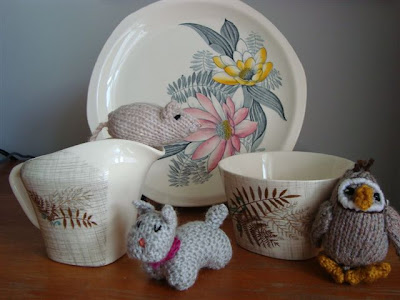
I recently discovered that a car-boot sale takes place every Sunday morning in the nearby suburb of Browns Bay. It's a great old-style market in the massive open car-park with a huge array of new and vintage wares displayed on trestle tables and blankets laid down on the concrete. I found a Meakin jug and bowl with a leafy pattern, a pretty hexagonal floral plate, and these miniature knitted toys made by a granny from Hamilton. Too cute! The Browns Bay market will definitely become a regular Sunday morning activity from now on.